Work that Network to find Great professional Real Estate Agents and Inspectors

The state of Oregon has a regulation system for home inspectors and home inspections (check out the Oregon State Standards of Practice for Home Inspections). These regulations have created minimum levels of competency and insurance and this has been a very good thing for consumers.

In some states it is still possible to hire a home inspector that has no more training than to buy a flash light and a screw driver. There will be good home inspectors in most areas but weeding through the new screwdriver/flashlight business owners can be more challenging.
A good agent can still open doors

My number one source of business is referrals. I dearly appreciate the agents that are willing to put their good names and the safety of their clients in my hands. This level of trust is not taken lightly. Local Real estate can be a very small community and inspectors that make a habit of providing less than the absolute best can get known for that.

If you are shopping for a home inspector start with the real estate agents. State licensing is a good start but the reality of day in and day out performance will only be realized on the ground an in the community.

It just makes sense for a person that does not work in the field of real estate to trust a good advisor. A good agent is much more than a creature that can open a door for you.

Probably the number one thing a home buyer/seller can do to ensure a  trouble-free transaction is to- find a great agent. Through education, training, and plain old feet on the ground experience a good agent can help advise a home buyer/seller on every phase of a transaction.

Finding a good agent is not always easy. It will take time so start early. I spent about two years doing home inspections before I found a referral base that I felt really good about. Agents that cared about their clients more than the deal. Agents that realized that their job was that of an advisor and not a warm body to open a door. Two years of total immersion it took for me to find those agents. Most people don’t have two years to spend on the task of meeting an agent but a little more reasearch than calling the phone number on the sign should be considered.

First place to start is your circle of influence. Most adults have had experiences with agents. Ask local people like your doctor, repair contractor, and friends and neighbors. Get a few names of some good agents and then hit the web. Many good agents have blogs and a Google search for local agent blogs can turn up a lot of useful information.

The beautiful thing about an agent’s blog is that you can get to know that person before you actually meet! Face to face interaction is great but some times it can be difficult to get to know someone by having a few minutes if conversation in their office.

Bank Owned Problems

With more and more banks acting as the primary owner of homes I am starting to see more and more ridiculous decisions.  Issues that would never come up for a home owner are now manifesting due to the utter lack of common sense displayed by most banks when home ownership is their new responsibility.


Recently I got the chance to inspect a bank owned property here in Salem, Oregon.  It was cool the morning of the inspection but not unusual (the high 20’s).  The bank in their infinite wisdom turned the water to the home on, for the inspection.  But……some one forgot about the heating system…… The agent, client and I walked into the home and discovered a large pool of water on the floor of the kitchen and dining room and rain falling from the kitchen ceiling!

Although the leakage was awful, it was still manageable.  The water had not been there for very long and the wood flooring was not even warped, yet…..  I turned off the water and grabbed some towels to try to sop up the majority of the water.  We rescheduled the inspection and hoped that the bank’s reps would properly dry the home before serious damage occurred.

Three weeks later….the bank just got the heat on!!!!  During the subsequent home inspection I find typical water damage issues and ceilings, walls and flooring that is still wet!  A good general rule of thumb is: if water is uncontrolled in a home for as little as 24 hours, mold can start to rock and roll.  I did not do any mold testing in this home but I just can’t help but wonder what the second floor joist bays look like.  Hmmm…wet wood and paper for 3 weeks, I think it is probably very fuzzy with fungal growth.
As many of you may know, when dealing
with short sales and banks you have to leave
common sense at the door.  Even with this premise it is still disappointing that over
and over again it seems that banks
are so ill suited to be primary owners of homes that they spend dollars to save pennies.


Jim Allhiser President/Inspector
http://SalemOregonHomeInspections.com
503.508.4321         jallhiser@perfectioninspectioninc.com

“Always on the cutting edge”

Page copy protected against web site content infringement by Copyscape
Bookmark and Share

Parts and Inspection of a Water Heater (part 4 of 4)


Water heaters in general are reliable for around 10 years.  They can last much longer or they can start to fail after 5 or 6. (the oldest I have seen was a 68 year old electric water heater that was still cranking away!)  Among other issues with water heaters, the age is a good indicator of when the unit may start to fail or when you may need to replace the unit.

The thing I look at, when I am inspecting homes in Salem, Oregon and the water heater is the name plate:

The name plate will give most all of the information we need to determine the size and age of the unit.  Some times the age is very obvious and there will actually be a label that states when the unit was manufactured.  Most of the time you have to look in to the Serial Number. With most brands the year will be the second 2 numbers in the serial number.

Bradford White apparently insists on being difficult because they use a secrete spy code on their tanks and you need to bring your box-top decoder ring.

In this first picture you can see the location of the serial number:


This next picture shows the two letters that are significant for determining the date of manufacture of this particular water heater:


At this point we get out our secrete spy decoder ring (or try a Google internet search):
and we can see that this tank was produced in October of 2005.  Meaning it is a 4 1/2 year old tank.


At this point I am tired of talking about have concluded some brief ideas on what to look for when looking at these super stylish modern appliances.  You can check out my earlier posts here:  More water heater information


Jim Allhiser President/Inspector
http://SalemOregonHomeInspections.com
503.508.4321         jallhiser@perfectioninspectioninc.com

“Always on the cutting edge”

Page copy protected against web site content infringement by Copyscape
Bookmark and Share

Parts and Inspection of a Water Heater (part 3 of 4)

There are a few things to look at when inspecting this oh-so mundane of household appliances.  If you have read my earlier posts or seen the MythBusters, you would understand that the pressure and temperatures contained in this vessel are nothing to be taken lightly.

Properly Installed Seismic Straps

The next thing I look at when I am inspecting homes in Salem, Oregon and the water heaters therein:

Seismic Straps:
In other parts of the world this may not be a very important issue but  around Salem, Oregon the earth shakes from time to time.  Knowing what we know now about the bomb that is our water heater we know that we shouldn’t mess around too much and expose it to rupture or other damage.  The best way to protect the heater is to strap it to the structure and make sure it doesn’t tip or fall over.
The straps need to be installed with one in the upper third of the tank and one in the lower third of the tank.  These straps should be tied securely to structure with lag bolts.
With these two straps installed properly, minor earth quaking should not cause damage to your water heating system.

I will discuss the other importan
t items in the next posts…….

All content is Copy written and is the property of Perfection Inspection Inc. Any usage that is not expressly permitted by Perfection Inspection Inc. is  infringement and is punishable by law.


Jim Allhiser President/Inspector
http://SalemOregonHomeInspections.com
503.508.4321         jallhiser@perfectioninspectioninc.com

“Always on the cutting edge”

Page copy protected against web site content infringement by Copyscape

Parts and Inspection of a Water Heater (part 2 of 4)

In my first post I wrote about the safety issue of having a standing flame in the garage and how the water heater should be installed to prevent unwanted fires.  Water heaters are heated water under pressure and there are a few very important safety devices that need to be just so, and anyone who watches MythBusters knows that water heaters, gone wrong, can be devastating……
The next thing I look at when I am inspecting homes in Salem, Oregon and the water heaters therein is:

The Temperature and Pressure Relief Valve (TPR)
This is probably the single most important safety device on water heaters.  This is a simple valve that allows gas/steam/liquid to leak if the pressure or temperature gets too high.
In recent years TPR’s have become very standardized, mounted on the tank, but older models still may have the valves on the hot water line.  This condition will cause a home inspector to gripe and is not as safe as the valve on the tank but if you do notice this condition it is most likely time to replace your whole water heater.
With the TPR in a standardized location it is now time to add the extension piping.  Yes, extension piping is important!  Remember that TPR valve is a release valve just waiting for the temperature or pressure to get to high.  When it releases it may do so with a significant amount of steam and super heated water.  The extension piping ensures the steam exhausts near the ground and not in anyone’s face.

The pictures are perfect examples of how NOT to pipe the TPR!

I will discuss the other important items in the next posts…….


Bookmark and Share


Jim Allhiser President/Inspector
http://SalemOregonHomeInspections.com
503.508.4321         jallhiser@perfectioninspectioninc.com

“Always on the cutting edge”

Page copy protected against web site content infringement by Copyscape

Parts and Inspection of a Water Heater

Sexy, stylish and fashionable your water heater is not. (unless you have one of those tankless systems, but that is another blog)  Your water heater is an important part of modern living and it really makes indoor plumbing enjoyable.
There are a few things that I look for and that are important when I am inspecting homes in Salem, Oregon and the water heaters therein, the first thing is:


Where is it?

If it is in the garage there are a few rules that need to be followed for safe operation.  If it is gas, the flame source needs to be at least 18″ off the ground.  This condition will apply to gas units th
at are more than 4 years old because we have now gone to a sealed burning unit that does not have an exposed flame.  If you can get to the pilot light so can combustible gasses.  Combustible gasses in garages tend to hug the ground so if the flame is sealed or 18″ off the ground it will help prevent those combustible gasses from igniting.

I will discuss the other important items in the next posts: Part 2, 3 and yes even 4!


Jim Allhiser President/Inspector
http://SalemOregonHomeInspections.com
503.508.4321         jallhiser@perfectioninspectioninc.com

“Always on the cutting edge”

Page copy protected against web site content infringement by Copyscape

Mark Gagle’s take on Salem, Oregon Heating and Air Conditioning

Mark Gagle, owner of a local Salem, Oregon heating/air and plumbing company; Gagle’s, answered some questions I had on AC.  Specifically I asked about size of the outside unit in relation to the sqft of the home and fenestration (windows and general heat loss) and one-story compared to two-story homes:

“If it is a newer home the windows, doors, insulation and direction facing are
not as critical on homes built from the mid 90’s to date. Anything prior to around
1994, the homes were not as well insulated and the windows and doors are more
of a factor. The most important factors for A.C. are the size of the return air coming back to the furnace/air handler and the location of the supply
registers for the second story of a home
.
If you have a single story home;
650ft. per ton is great. If you have a two story, main floor and upstairs, go
down to 550 to 600 ft. per ton.


What I’m finding out there is a lot of homes
were designed for heating only
, and not for adding A.C. The supply registers for
the upstairs need to be in the ceiling, not the floor! Warm air rises, but cold
air drops. In heating mode, the upstairs works fine because the main floor is
helping to heat the upstairs. But in cooling, unless the registers are in the
ceiling, you won’t cool the upstairs!  On most two story homes, the bedrooms are
all upstairs, and that is were you want cooling.


Another factor is the
thermostat location. It is usually located in a hallway, under or near a return
air grill. That is perfect for a single story home. By drawing air across the
stat going into the R/A [return air] grill you are always getting a accurate reading of the
indoor air temp. But the stat is also the systems sensor, and that is why the
upstairs is always warmer with a two story home. Once again warm air rises, so
all the heat from the main floor ends up upstairs! The same principal is true
for a main floor/basement home. Most two story homes have a 5 to 10 degree
temp. difference between floors.


As for return air duct sizing back to the furnace
for adding A.C.: a 14″ round duct is good for a 2 ton system. A 16″
round is good for a 2 1/2 to 3 ton system. A 18″ round is good for a 3 1/2
to 4 ton system. A 20″ round is good for a 5 ton system. These numbers are
for the max. size for adding A.C. If you don’t move enough air across a A.C.
I.D. coil you will turn it into a block of ice, and have to put the system into
heating to defrost the coil! The round sizes can be converted into rectangular
by multiplying by 3.14 (Pie) That will give you the sq. inches needed for
rectangular ducting.”


Of course this information is above and beyond what a home inspection is about (general visual inspection of systems) but it is still a good thing to know about as it may help me educate my clients more thoroughly.

If you have specific questions about duct sizing and AC/Heating system function refer to a Salem, Oregon Heating and Air contractor, but for questions about general systems, including structure, plumbing, electrical, kitchen appliances, etc….ask me, your Salem Oregon Home Inspector.


Jim Allhiser President/Inspector
http://SalemOregonHomeInspections.com
503.508.4321         jallhiser@perfectioninspectioninc.com

“Always on the cutting edge”

Page copy protected against web site content infringement by Copyscape

Wood Chip siding/OSB Problems and Maintenance Ideas Noted on Salem Oregon Home Inspections

As wood products have become more and more expensive the search for a viable inexpensive alternative has intensified.  In the world of siding real wood is still hard to beat.  Real wood sheds liquid water and allows water vapor to effectively come and go.  Solid wood is really a fantastic siding material but it is expensive so creative companies have been trying to develop a product that could be made from wood by-product (wood chips and fiber).

Wood chip siding has been around for many years but in the late 80’s and early 90’s a certain type of OSB (Oriented Strand Board) siding really became popular around Salem, Oregon and the Pacific Northwest.  The type that really had issues was the lap type made by Louisiana Pacific (LP).  This product had an adhesive that did not resist moisture effectively, and because proper sealing with primer and paint and continued home owner maintenance cannot be counted upon, the siding began to absorb moisture very quickly and began to deteriorate (grow mushrooms/fall apart).

LP went back to the drawing board, made some adjustments and continued to produce a very similar “wood chip” lap siding.  The adjustments were made to the sealing process.  They primed the entire board at the factory not just the front face, and they put a bevel on the drip edge of the siding that would help water drip off instead of being absorbed.

Wood chip siding also comes in panel form and although it is a similar product to the lap siding it doesn’t have as high of a percentage of vulnerable areas.  With the lap siding the bottom drip edge and all the other edges (only the front face is really the only durable side) are vulnerable and should be actively sealed/maintained with primer

and paint.  The panel boards come in 4’x8′ sheets and again only the edges are vulnerable but the damage resistant surfaces (again the front face) are much larger per piece.  The panels edges still need to be sealed actively.

One of the most common mistakes I see on home inspections around Salem, Oregon is the very bottom edge of the siding not getting painted.  Of course I carry a mirror that makes it easier for me to see that bottom edge that is only 8″ off the ground, but even with out fancy home inspector g ear you can get down on your knees and make sure this most vulnerable of areas gets sealed.  Both panel and lap siding have this issue and usually from waste down is where the lap goes bad and the very botto m is where the panel siding doesn’t get painted and begins to fail.

Now what is “failure/deterioration/dry rot?” In one of my earlier posts I wrote about “dry rot,” and why I do not use that term.  I prefer to use the term deterioration and basically that refers to a level of hardness or lack-of-hardness.  A good rule of thumb is: “If you poke it with your finger does it flex easily?” or (and if you are looking to buy a home that is not yours yet please leave this method to the professional home inspector) “Will a screwdriver/awl/knife point penetrate easily?”  If the answer is “yes” to either of those questions then the siding will not be able to sufficiently hold on to primer/paint and therefore it will not be able to shed water effectively and will continue to deteriorate and possibly begin to allow deterioration of related areas of the home (wall structure).

Some of the composite (wood chip/particle) sidings begin to swell when the paint is failing and allowing water to be absorbed.  Sometimes this swelling can be stifled with prudent and active painting.  But again the siding has got to be “hard” still. If it flexes it will not be able to hold on to the paint that will prevent further moisture absorption and will need to be replaced.

As the siding products have evolved, there have been good and not so good products.  The siding’s job is to shed water while allowing water vapor to come and go.  This job must be achieved while striving for low cost, durability, and ease of installation.  The “wood chip,” siding met a few of those needs, low cost and ease of installation, while suffering in the durability aspect.  However with knowledge of this type of siding’s vulnerabilities and active/aggressive maintenance it can be a lasting and effective siding system.


Jim Allhiser President/Inspector
http://SalemOregonHomeInspections.com
503.508.4321         jallhiser@perfectioninspectioninc.com

“Always on the cutting edge”
Page copy protected against web site content infringement by Copyscape

Pest and dry rot? Salem, Oregon home inspector defines “dry rot.”

Earlier I wrote two posts (Part 1 ad Part 2) on the terms: “pest and dry rot.” I detailed what the inspection was about and what the term “pest” might mean. Now I will try to describe the term “dry rot.”

IMG_3067

Wood destroying Fungus on a Salem Oregon Home Inspection

In the real estate world any rot or deterioration refers to dry rot. The term is a bit confusing because all fungal deterioration requires moisture. The term dry rot actually refers a very specialized fungus that actually consumes wood that is dry or does not have a available water source.  The fungus actually grows hyphie (root like structures) up to 8 feet long! These root structures reach out from the dry piece of wood into the ground and collect and shuttle water to the dry piece of wood.

This type of fungus is very unusual around Salem, Oregon and I have only seen it twice in 5 years of inspecting homes!
Most all of the deterioration that I see is caused by a white rot or a brown rot. Both are fungi and both require direct and chronic exposure to moisture to allow them to consume the cellulose or lignin in the wood.

I know, I know this is earth shattering news.  But you can see why I prefer to call damaged wood: “deterioration” rather than “Dry Rot.”

Builders are Just Human or You Still Need a Home Inspection on a new Salem Oregon Home

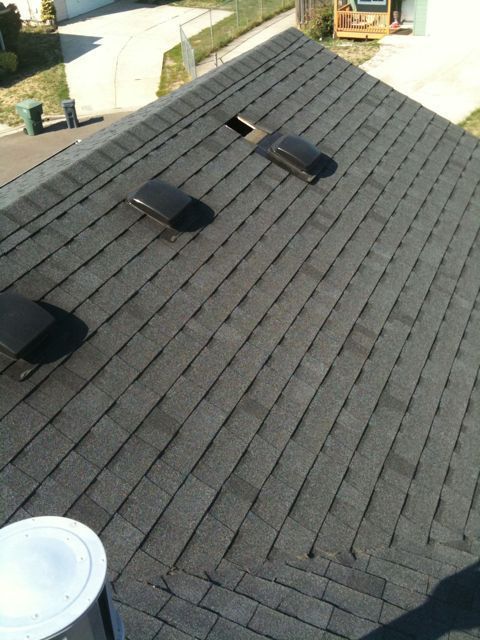
I was poking around one of the many good deals in real estate here in Salem, Oregon the other day and I noticed this “small” roof leak.

I love my job.  Above and beyond me finding problems with my client’s new homes, my job is to educate them on how their home works.  Most people who are willing to climb on a roof could notice that this roof vent is out-of-place but explaining the vital function of the roof vent is my job and I love it.

Home inspections are more than just a check list of the “problems” in a home.   They are a great start in the educational process that we as homeowners need to actively pursue.