Aluminum Wiring

Written by:  Jim Allhiser President/Inspector
When I trained to become a home inspector I went to a national school and learned about all sorts of things that good home inspectors should be aware of when inspecting homes.  Over the years of doing inspections in Salem, Oregon I have noticed real patterns in building materials that were not reflected by the home inspector schooling.
Bricks for one thing are very popular in other parts of the country.  My schooling spent hours on the issues that can be noted with brick siding.  We have brick siding here, but at a very small percentage compared to the east and the south.  Most of this difference has to do with the shale that composes bricks.  We do not have shale mines on the Pacific coast and so if you want brick it has to be shipped in from the south or east.

Recently Chinese Drywall has received quite a bit of media attention.  That stuff is bad news but for all of the newly built homes that I am inspecting, none of the associated issues have manifested.  I have been looking for it and well educated home buyers have been asking about it but it seems that  our area did not receive the supply of drywall from those particular problem vendors.
Aluminum wiring was also a large topic of education at the home inspector training.  It is also another material that, for whatever the reason, we North-westerners largely managed to escape.  From the mid 60s to the early 70s aluminum was widely used for the smaller (15 and 20 amp) branch circuits in homes.  Problems occurred when the small aluminum wires were used with devices that had connections specifically designed for copper.  Aluminum also tends to expand and contract more than copper (which can cause loose connections) and it can corrode (which is an insulator), all bad things when consistent conduction is desired.  These issues lead to house fires and if your wiring is a fire hazard it is a very big deal!  I have seen and heard of small aluminum branch circuits in manufactured homes in this area but I have only seen one stick built home that had aluminum wires in 5 years!
The more experience I gain the more specific my inspections become, relating to the issues with Salem, Oregon homes.  Still, I can’t forget about those nationally recognized issues.  A great home inspector not only needs to know about homes in this area but also about building products that are not generally used in this area.


Jim Allhiser President/Inspector
http://SalemOregonHomeInspections.com
503.508.4321         jallhiser@perfectioninspectioninc.com

“Always on the cutting edge”

Page copy protected against web site content infringement by Copyscape
Bookmark and Share

Dryer ducts- The “Forgotten About” Fire Hazard

Written by:  Jim Allhiser  President/Inspector


The consumer product safety commission estimated that in 1998 clothes dryers were associated with 15,600 fires, which resulted in 20 deaths and 370 injuries!
A vast majority of these fires could have been prevented with a little home owner style maintenance.
The duct work that exhausts all of that warm dryer air is usually the culprit, and as far as routine home owner maintenance, is usually completely forgotten about.
Ideally these ducts should be hard and completely smooth.  This minimizes the slow down of the hot air that will cause lint to build up.   This means that the flexible corrugated metal ducts that all do-it-youselfers love are terrible.  Everyone of those little ridges in the duct pipe create turbulence that slows down the flow of air.

Fire hazard or Dryer duct? Both.

Even with hard ducting the joints are a critical point of contention.  With forced air furnaces, the joints between one hard duct to another, are usually secured with sheet metal screws.  If this technique is put into practice with dryer ducts all of those sharp little screws that are in the flow of air act as lint catchers.
The moral of this story is:  If you have not cleaned your dryer and ducting recently it is time to do so.  If you have an issue with the duct and need to install a new duct, it is usually best to hire a professional to install a HARD DUCT with proper seams that are TAPED and not screwed together.
My job as a home inspector requires me to crawl and poke around other people’s homes every day and this is one of the most neglected fire hazard that I see.
Jim Allhiser
President/Inspector
All content is Copy written and is the property of Perfection Inspection Inc. Any usage that is not expressly permitted by Perfection Inspection Inc. is  infringement and is punishable by law.
Bookmark and Share

That’s what that thingy is for??

The most important part of a good home inspection is the education about the home.  Above and beyond the defects that good home inspectors will find, helping the new home owners understand the weird knobs and switches that are in a typical home is really where good inspectors earn their wage.
One type of knob in particular that I see often in more recently built homes is the “hose bib winterization valve.”
It seems simple enough however they usually are not anywhere near the hose bib (outside water faucet)!
In a two-story home, these valves are usually stuffed under an upstairs bathroom sink.  The placement is good because if you shut the water off and open the bleed valve the water will readily drain out the outside water faucet.
If you have a recently built home and see one of these under the sink:
you now know what that weird thingy is for.


Jim Allhiser

President/Inspector
http://SalemOregonHomeInspections.com
503.508.4321         jallhiser@perfectioninspectioninc.com

“Always on the cutting edge”

Page copy protected against web site content infringement by Copyscape
Bookmark and Share

Picture/Thermal Challenge for Salem Oregon home Inspections

I have been having so much fun with Perfection Inspection’s fan page and my picture challenge I decided to branch out and have it help me get some Google juice.

The idea is:  I post a picture, thermal/infrared or interesting visual picture that I capture on a recent home inspection.

Then you guess what the picture is.

  • I am toying with the timelines but for now I will post for 1 week and at the end of that week I will post the answer and the first closest guess gets a $5.00 Starbucks card.
  • Only one guess per person and the moderator will be the sole decider of the closest guess.
  • People that I think know the answer (because they were at the inspection where the image was taken) will be excluded

Now enough with the legal disclosures and on the the challenge:

What is it?

New hands free device

Thank you Salem, Oregon for helping to keep me safe.
With the new rules, since 1/1/2010, we are no longer allowed to talk on cell phones while driving without a hands free device.


Now instead of the distraction of holding a phone up to our heads we are all forced to be distracted with blue tooth thingys that don’t work right, speakers that are unintelligible and the whole process of setting up and getting used to a new piece of technology while driving.


The fine folks @ Ticor had a nifty educational get together last fall in preparation for the new law.  I was doing home inspections and was not able to attend the event however I did see some of the “hands free” devices that they were showing off.


One in particular caught my eye. I liked the simplicity and the durability and I knew that I just had to have it:


It is sooo trendy and new you probably won’t see anyone but me wearing them.  Maybe the movie stars will get theirs for the summer!


Jim Allhiser

President/Inspector
http://SalemOregonHomeInspections.com
503.508.4321         jallhiser@perfectioninspectioninc.com

“Always on the cutting edge”

Page copy protected against web site content infringement by Copyscape
Bookmark and Share

Mold, Lead, Arsenic, Radon, Wet Crawlspaces and other things that

Toxic Talk was the title of the Salem Association of Realtor’s Educational Event yesterday.


I wanted to give everyone a quick review of the information that I learned:


Radon: It will kill you.  Any home might have an issue.  It comes out of the ground and even with a well ventilated crawlspace your home can concentrate this poisonous, radioactive gas.
Moral: Get your home tested


Arsenic in Water: It will kill you. Wells will be required to be tested for it during a real estate transaction.  If you have it and install a filter CHANGE YOUR FILTER carefully and regularly.
Moral: Get your water tested


Disaster Clean-up:  It will kill you. (see a pattern developing?)  Rodent urine and feces is a toxic bio hazard
Moral:  Hopefully you won’t have to call these guys EVER!


Lead: It will kill you. (yup, believe it or not)  Soon Oregon is going to have some changes that require certifications of ANYONE dealing with repairs of older homes and mandatory lead testing of all of these homes!
Moral:  Whether you like it or not your home will be tested…..


Mold: (everyone now!) It will kill you.   Mold is EVERYWHERE and it is not necessarily the issue but an indicator of moisture conditions that are a problem
Moral: Get your home tested.


Crawlspace/basement leakage: This will probably kill you too but I think the moisture just causes stuff that will kill you….    Crawlspaces and basements are swimming pools and although there are ways to minimize the water intrusion, they are not required by code.
Moral:  Pay a good Home Inspector to check out your crawlspace BEFORE you sell!


Jim Allhiser President/Inspector
http://SalemOregonHomeInspections.com
503.508.4321         jallhiser@perfectioninspectioninc.com

“Always on the cutting edge”

Page copy protected against web site content infringement by Copyscape
Bookmark and Share

Helpful presentation to keep you from getting Burned!

Unfortunately WordPress doesn’t seem to want to allow me to embed my presentation this morning so you all will have to bear with me and click on the link below:

Water heater temperature adjustment presentation

Bookmark and Share


Jim Allhiser President/Inspector
http://SalemOregonHomeInspections.com
503.508.4321         jallhiser@perfectioninspectioninc.com

“Always on the cutting edge”

Page copy protected against web site content infringement by Copyscape

How NOT to build a Deck, Adventures of this Salem, Oregon Home Inspector

There can be many different ways to come to a good looking finished product.  Skimping here or there can be ok depending on what you are dealing with.  From what I look at day in and day out, if you are installing anything outside it should be the best you can afford and maybe a little better.
I am not talking about the finishes.  People tend to get caught up on what they can see and understand, which makes sense.  But the parts that hold up those wonderful jungle hardwoods or space age composites are the things that are really important.
Take decks for instance:  A deck that was on a home that I inspected in Salem, Oregon recently appeared to be beautiful.  Composite decking boards (low to no maintenance), and aluminum railings (again low to no maintenance) all appeared to be installed properly and should last a long time.  The real issues didn’t make themselves visible until we got a look at the structure……
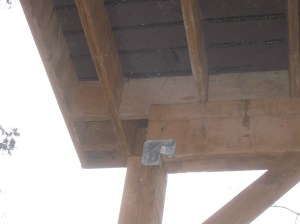
The first thing that jumped out was the outside structural beams, or lack there of.

I can’t tell if, to save money they didn’t think they needed to extend the
support all the way to the edge or if they got the wrong beam in the first place and again decided to ‘make it work’ instead of getting the proper sized beams.
Either way this set up is really a classic example of how not to build a deck.

Jim Allhiser President/Inspector http://SalemOregonHomeInspections.com 503.508.4321         jallhiser@perfectioninspectioninc.com

“Always on the cutting edge”

Page copy protected against web site content infringement by Copyscape
Bookmark and Share

Wet Crawlspaces,…Ok what now?

Being a home inspector lets me witness a condition that pops up fairly often in Salem, Oregon, area: Water in crawl spaces.  Home inspections do not allow me participate in diagnostics very often but sometimes I do get called out to diagnose where water is coming with my high-tech infrared camera.

Crawl space construction in this area is very popular for a few reasons.  The two main reasons are; one: it takes less concrete, read- Cheaper. and Two: it puts the wood members of the house up off the ground when our high water table potentially allows water to bubble up from the ground.  Ideally crawl spaces should not be wet however it is not a terribly uncommon issue in this area and  the main culprit is the gutters and downspouts and what they are up to when they go underground.

Right after the foundation is poured, the underground piping is installed.  This means that every other trade that is working on their part of the home has to step over the newly installed plastic pipes.  Once the pipes are covered up, near the end completion of the home it is sometimes out of sight and out of mind.

The most compelling evidence I had for this condition was on a listed home that had an offer and a home inspection.  The sellers called me out to try and locate the source of the water.  After some trial and error per my suggestions the handy home owner disconnected the downspouts and shoved the garden hose down the pipe and filled the pipe with water.  He went into the crawlspace and noted the water bubbling up under the foundation near his front door.


The door had a nice slab of concrete leading to the entrance so the home owner rerouted that troublesome pipe into a drywell near the perimeter of his lot and promptly dried up his wet crawlspace.


Diagnostics don’t always work like that but for years I have seen water in crawl spaces and a majority of the time I can find the gutter and downspout that is the contributor.

You can find more information on crawlspaces here:

Crawlspaces need love and attention too

Problems under the Surface

Your cat is Killing this Salem, Oregon Home Inspector and your Home’s crawlspace


Bookmark and Share


Jim Allhiser President/Inspector
http://SalemOregonHomeInspections.com
503.508.4321         jallhiser@perfectioninspectioninc.com

“Always on the cutting edge”

Page copy protected against web site content infringement by Copyscape

My home inspection is better than yours!

Thermal imaging has been an absolute game changer for the home inspection industry. About eight years ago my wife and I bought our first home in Salem, Oregon. At that time I worked in construction and I was a pretty hand dude but I knew very little about furnaces, electrical systems, plumbing and many other integral parts of a typical home.

The home inspector that we hired requested that we not show up till the end of the inspection. I didn’t really like that advice so I showed up went he began his inspection. That excuse for an inspector spent about 45 minutes in our 1950’s fixer and didn’t say more than a dozen words to me, even though I was asking him questions constantly. He didn’t even introduce himself!!

Upon moving in we realized that the furnace didn’t work, the bathtub had a leak and the shower head barely had enough spray to get you wet!

A year pasted before I learned of thermal imaging and how their were a few inspectors across the country that were using this wonderful technology to offer more and better knowledge for their clients. I took the leap and be and became home inspector.

Yup. Thats a leak in this new house

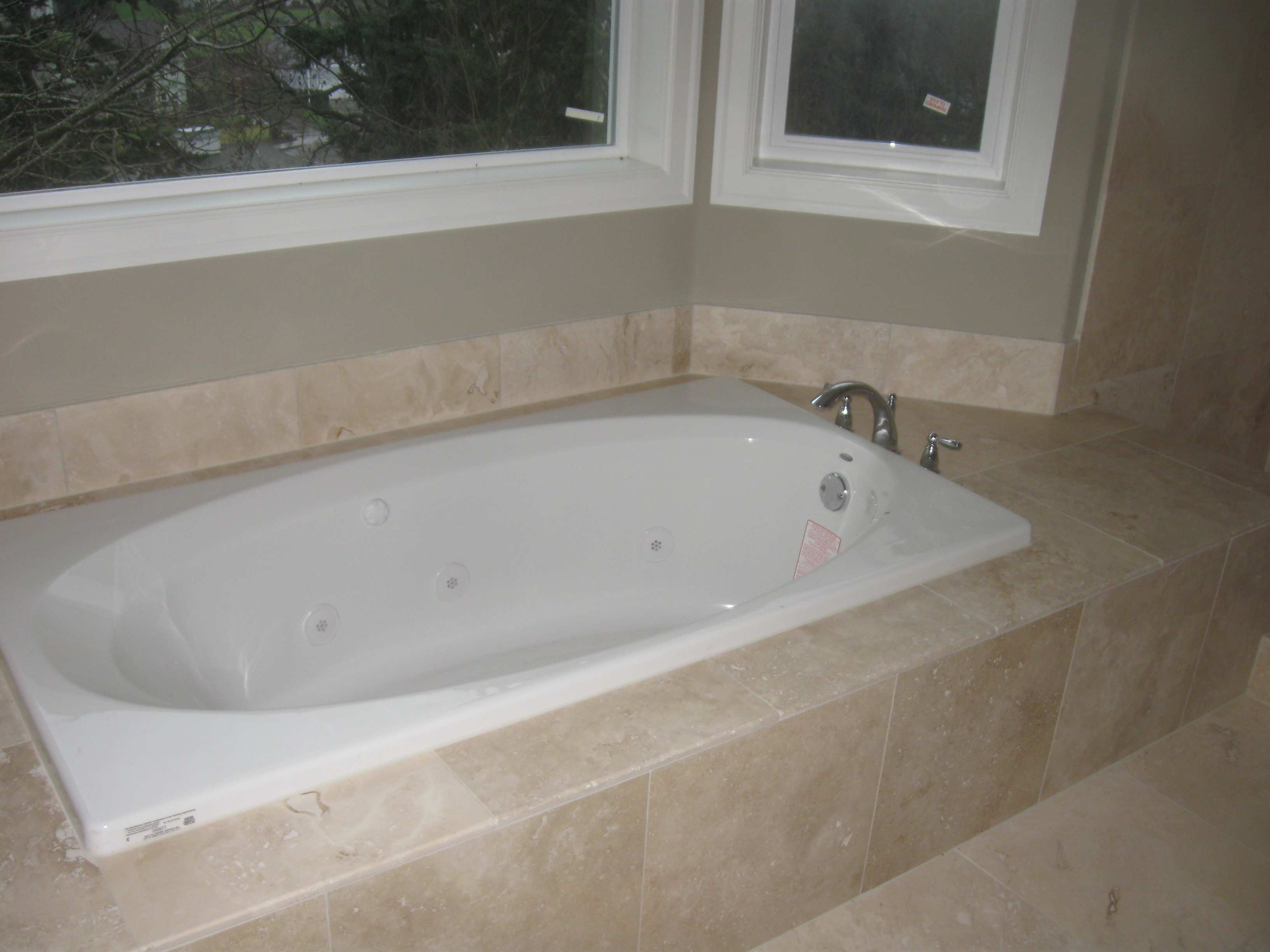
Yesterday I inspected a new home and with out my fancy little camera my clients would not of known about a plumbing leak. The leak was in the upstairs master tub and it had not caused any finish damage yet……

Equiped with the knowledge that I provided my clients were able to save the ceiling in their kitchen/dining room, the flooring in this area and all of the head aches that go along when you have to do major repairs to your home.